
The Auction House Is a Game Inside the Game
I remember sitting in a dimly lit room at 3:00 AM, staring at a spreadsheet of herb prices for a private server that would be dead by Christmas. I wasn’t playing the game; I was playing the market, and the market was winning. Most designers think they’re building a vibrant, player-driven ecosystem when they launch a trading hub, but they usually just end up building a high-speed treadmill that forces players to choose between actually playing the game or becoming full-time data entry clerks. We talk about these systems as if they are neutral tools, but we rarely stop to analyze how auction houses shape play by effectively turning your leisure time into a second job you didn’t apply for.
I’m not here to give you a lecture on supply-and-demand curves or some academic breakdown of liquidity. I’ve built my own systems, broken them, and watched players revolt when the “economy” felt more like a cage than a playground. In this post, I want to look at the actual sentences these systems are writing—the ones about scarcity, exhaustion, and control—and help you understand why your favorite MMO feels more like a stock exchange than an adventure.
Table of Contents
Digital Scarcity and Demand the Lie of the Limited Resource

The problem with most designers’ approach to digital scarcity and demand is that they treat it like a math equation when it’s actually a psychological hostage situation. They think if they drop a “one-of-a-kind” mount or a rare crafting reagent, they’ve created value. But in a world where the supply is controlled by a server script rather than a physical limit, that scarcity is a lie. When I’m coding my own little project, I see how easy it is to accidentally create infinite value just by tweaking a drop rate, which completely breaks the in-game asset valuation you were trying to build.
Real value doesn’t come from the item being rare; it comes from the friction of getting it. An auction house is supposed to be the venue where that friction is resolved, but it often becomes a place where players stop playing the game and start playing the market. You aren’t fighting dragons anymore; you’re fighting the player-driven market trends set by three guys in a guild who have nothing better to do than corner the market on iron ore. The moment an item becomes a tool for speculation rather than a reward for effort, the “scarcity” stops being about the item and starts being about who has the most time to sit in the UI.
Item Liquidity in Gaming When Trading Becomes the Only Game

The problem with high item liquidity in gaming is that it can accidentally turn your combat loop into a background process. When you make it too easy to flip a rare drop or liquidate a stack of herbs into raw gold, you aren’t just facilitating trade; you’re changing the player’s primary motivation. I’ve seen it happen in my own small projects—you think you’re building a robust virtual economy mechanics framework, but what you’ve actually built is a job. Instead of playing the dungeon to see the boss animation, players start playing the dungeon just to check the in-game asset valuation of the loot they might find.
Once the market becomes too efficient, the game stops being about the experience and starts being about the math. When a player can calculate the exact gold-per-hour of a specific farm versus the market spread of an auction house, they stop being an adventurer and start being a day trader. At that point, the “game” isn’t the raid or the questline; it’s the screen where the numbers move. You end up with a situation where item liquidity in gaming becomes so high that the actual gameplay feels like an inconvenient chore required to fund the real activity: the market.
Five ways the market rewrites your game loop
- Watch out for the “Professionalization Trap.” When an auction house is too efficient, it stops being a tool for players and starts being a job for a specific class of player. If your gameplay loop becomes “check prices, list items, repeat,” you haven’t built an economy; you’ve built a spreadsheet simulator that competes directly with the actual combat or exploration you spent months coding.
- Remember that transaction fees are a psychological lever, not just a gold sink. A high listing fee tells the player, “Only bring your absolute best stuff here,” which kills the mid-tier economy. A low fee says, “Flood the market with junk,” which leads to the exact kind of hyper-inflation that makes new players feel like they’ll never catch up. You have to decide what kind of “sentence” you want that fee to write.
- Be wary of the “Information Asymmetry” problem. In a perfect world, everyone knows what a dragon scale is worth. In a real MMO, the guy who has been playing for 4,000 hours knows something you don’t, and he’s going to use that knowledge to vacuum up every undervalued item before you even finish your morning coffee. If the auction house rewards tenure more than skill, you’re building a wall, not a market.
- Design for the “Low-End” player, not just the whales. If the auction house only makes sense for high-tier gear, you’re effectively telling your casual players that their time and their drops don’t matter. A healthy market needs a way for the person who just found a slightly better iron sword to feel like they’ve made a meaningful transaction, otherwise, they’ll just stop engaging with the system entirely.
- Don’t mistake “Liquidity” for “Activity.” Just because items are moving doesn’t mean the game is healthy. If players are only interacting through the UI of the auction house rather than through social systems or world-based trade, you’ve accidentally incentivized them to avoid the actual game world. You want an auction house that facilitates the game, not one that replaces it.
The Final Sentence
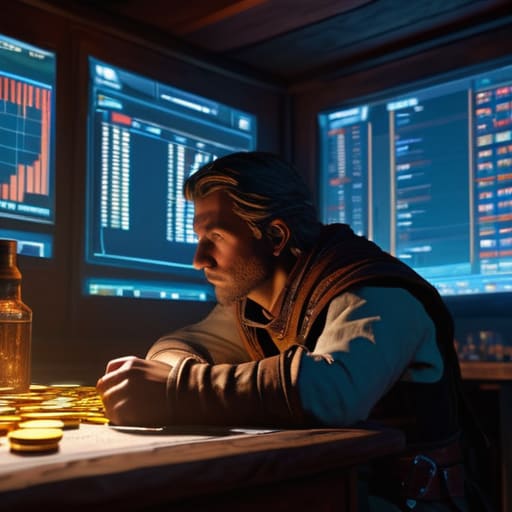
At the end of the day, an auction house isn’t just a menu where you click ‘buy’ on a piece of gear; it is a massive, living statement about what a game values. We’ve seen how the illusion of scarcity can turn a fun loot drop into a stressful commodity, and how high liquidity can accidentally transform a heroic RPG into a full-time job of market monitoring. When the auction house becomes the primary way players interact with the world, the game stops being about the adventure and starts being about the spread. If you aren’t careful, you aren’t designing a world; you’re just designing a spreadsheet with better graphics.
As I sit here staring at my own half-finished code, trying to figure out how to balance my own tiny economy, I keep coming back to one thought: we have to be intentional. Every button, every tax, and every listing fee is a word in a sentence we are writing to our players. If we want them to be explorers, we can’t build systems that only reward them for being professional speculators. The goal shouldn’t be to create a perfect, frictionless market, but to build a system that serves the fantasy instead of replacing it. Let’s stop building markets and start building worlds again.
Frequently Asked Questions
If the auction house is meant to facilitate trade, at what point does the "game" stop being about the combat or the world and start being just a spreadsheet simulator?
It happens the moment the “optimal” way to progress requires more time in a UI menu than in a dungeon. When the math of a market fluctuation becomes more impactful to your character’s power than your actual skill in combat, you’ve crossed the line. You aren’t playing a fantasy epic anymore; you’re managing a logistics firm. The game stops being about the world and starts being about the friction of the interface.
How do developers prevent the "sentence" of an auction house from becoming a sentence about wealth inequality, where the richest players effectively gatekeep the entire server?
To stop the auction house from becoming a tool for server-wide gatekeeping, you have to break the cycle of pure capital accumulation. Developers usually do this by introducing “friction” or “decay.” Think of soulbinding items, daily transaction limits, or tax sinks that bleed gold out of the ecosystem. If you don’t, the auction house stops being a marketplace and starts being a wall that the rich build to keep everyone else playing in the dirt.
Is there a way to design a player-driven economy that doesn't eventually collapse into a loop of hyper-inflation and market manipulation that kills the casual player's interest?
You can’t stop the math, but you can change what the math says. Most devs try to fight inflation by just adding more gold sinks, which is like trying to fix a leaky boat by bailing water faster. Instead, you have to design systems that consume value, not just currency. If your economy only ever moves upward, the casual player is just a spectator to a billionaire’s club. You need “sink” mechanics that actually matter to the gameplay loop, not just a tax on existing wealth.

